A new feature just landed on SightRead.org: mixing time signatures within a single exercise! This lets you practice switching between simple meters (like 4/4) and compound meters (like 6/8) mid-exercise: a skill that's essential for tackling real-world music.
How to enable mixed meters
Open the settings panel (⚙️) and select multiple time signatures. Once you have selected more than one, the "Allow multiple time signatures" option becomes clickable.
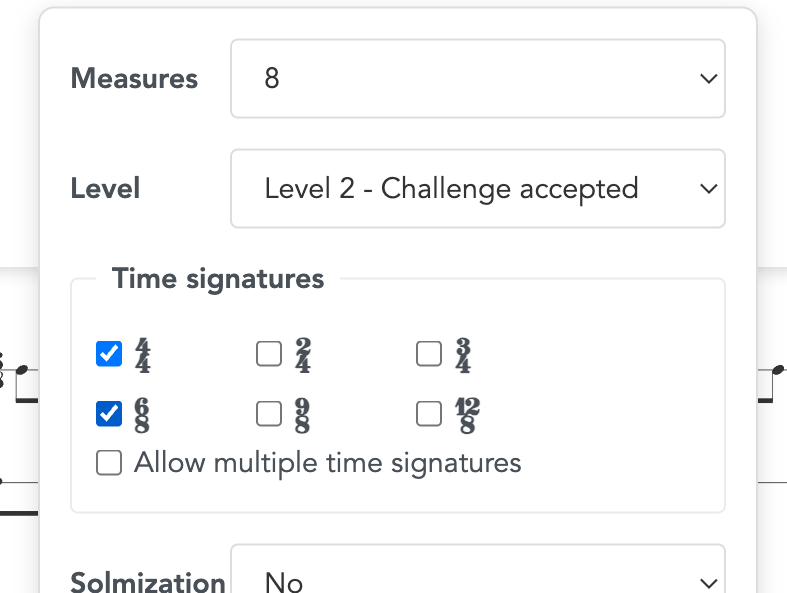
Check the box, and your exercises may now include mid-exercise meter changes. I say "may" because it's a dice roll, you may get 0 meter changes or 1, or 2, 3... you get the idea.
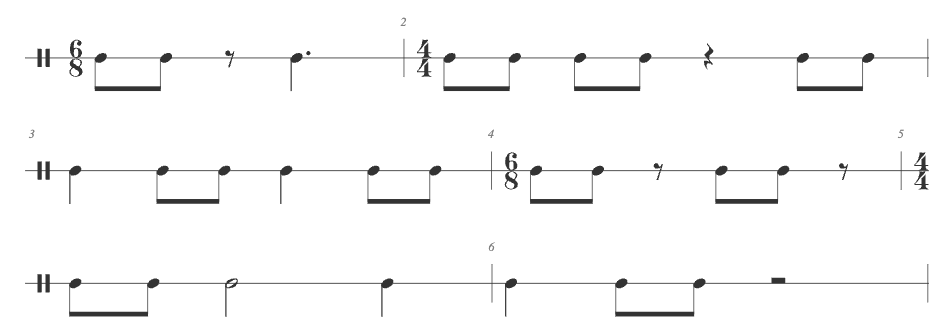
In the screenshot above, notice how the exercise starts in 6/8, switches to 4/4 in measure 2, back to 6/8 in measure 4, then 4/4 again, and so on.
Understanding the tempo: what does ♫= mean?
When you're working with mixed meters, you'll notice the tempo indicator changes from the usual quarter note (♩= for simple meters) or dotted quarter (♩.= for compound) to beamed eighth notes (♫=).
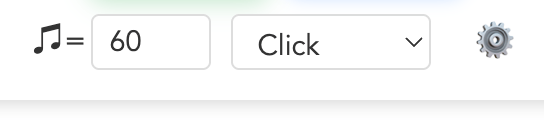
That's because the eighth note becomes the common pulse that ties everything together through the changes.
The challenge of mixed meters
In simple meters like 4/4, we typically feel the quarter note as the beat. In compound meters like 6/8, we feel the dotted quarter (three eighth notes) as the beat.
When switching between them, musicians need a common reference point. The solution: the eighth note stays constant.
At ♫= 60, a pair of eighth notes is the same duration as a quarter note. This prevents your tempo from suddenly halving when you enable mixed meters.
- In 4/4: A quarter note = 1 second (same as ♩= 60)
- In 6/8: A dotted quarter = 1.5 seconds, so you feel 2 beats per measure
When you switch from 4/4 to 6/8 mid-exercise, the eighth-note subdivision stays constant and the metronome clicks remain aligned throughout.
Why practice this?
Mixed meters appear throughout classical, jazz, and contemporary music. Composers like Stravinsky, Bernstein, and countless film composers regularly change time signatures. For film music specifically often folks have music in say 3/4 and then some measures in 4/4, 5/4, 6/4, etc, just to match what's on screen.
By practicing these transitions now, you'll be ready when you encounter them in real repertoire. Who knows, tomorrow you may be called at a film scoring session. And then you'll know what to do.
Happy sight reading! 👀